Welcome to Stems! We were mentioned in the NY Times the other week, when I offered a couple of thoughts to Ben Sisario for his report on the YouTube-Billboard charts détente (appreciate the link back!). In other news, I wrote a little thing on the father of computer music, Max Mathews, for a new Berklee College of Music publication, HRZN. As always, shoot tips and feedback to [email protected].
Was this forwarded to you? Get the next one by subscribing to Stems here.
 MUSIC • MEDIA • TECH
| Analysis |
TikTok Wants You to Believe It’s the Secret Sauce Behind Every Billboard Hit, But the Numbers Don’t Add Up

“You will promote your song with a paid boost … you will promote your song with a paid boost … “ (Giphy)
After reading TikTok’s latest study, you would be forgiven for asking, “Did music even exist before vertical videos?” The social video platform’s new study with Luminate, the 2026 Music Impact Report, makes big assertions — “TikTok is the Home of Music Fandom”; “TikTok Drives Music Culture” — that it backs up with impressive-sounding stats. Among them: TikTok users are 61% more likely than the average music listener to identify as members of an artist fan base, and songs that go viral on TikTok spend four times as long on the Billboard Global 200 as songs that don’t. There’s one headline stat that looms above the rest, though, and it’s gotten significant media attention: 94% of the songs that made Billboard’s Global 200 last year went viral on TikTok first.
To give TikTok credit: music has always been a key element of its appeal, and it has a long track record of breaking artists and songs. Its audience skews younger than those of most major platforms, and it’s great at creating new (OK, often kinda random) viral moments for older songs. But the implication that 19 out of 20 songs at the top of the charts bubbled up from its frothy mix is … pretty bonkers.
As usual with shaky data-driven insights, it comes down to causation versus correlation: How much credit can TikTok actually take for 94% of the Billboard Global 200? Let’s start with how the study defines “going viral,” which is murky, and, as we can infer, extremely broad. “TikTok virality,” per the fine print in the back of the deck, is the “week [the song] attained [its] earliest virality score, ranging from highest (8) to lowest virality (1).” Translation: TikTok is calling your song viral even if it only got a one out of eight on its ‘virality’ scale. And TikTok doesn’t say how its scores were calculated, or what scores individual songs received.
Another, connected problem is that the study lumps songs with sizable marketing campaigns into its 94% “viral” number, and makes no distinction between what’s paid and what’s organic. We can easily imagine that the marketing teams behind many of these songs were able to gin up a moment that scored at least a “one” on TikTok’s virality scale, by hook or by crook. Roughly half of the songs on the Billboard Global 200 during the study’s 2025 date range entered the chart the week of their release; these are not songs that had slow, organic, viral builds — these are songs with promotion plans. Can TikTok take credit for all of those making the charts? Or, in many cases, did “viral first” look more like decent engagement for a prerelease song clip backed by a paid TikTok marketing spend? (To further muddy the picture, there are guys like Chaotic Good out there who are vigorously blurring the lines between paid and organic marketing.)
For another angle, it’s worth looking at TikTok’s own music charts. The company doesn’t publish a public-facing one anymore (perhaps not an accident?), but from September 2023 until February 2025 — the month before this study’s window opened — it ran a weekly TikTok Top 50 with Billboard, which we compared against the Billboard Hot 100. (It’s not a pure apples-to-apples comparison, because the TikTok Top 50 was U.S.-only, and the Music Impact Report looks at global numbers, but it’s close enough.) Of the 751 new songs that made TikTok’s chart, 73% never made the Hot 100. And of the songs that reached TikTok’s top 10, roughly half never charted. When a song did chart on both, it showed up on the Hot 100 first more often than the other way around. In other words, going seriously viral on TikTok isn’t a guaranteed ticket onto the Billboard charts, by any means. So how much credit does TikTok deserve for a bunch of Global 200 songs that went … sort of viral?

TikTok is still the major labels’ go-to marketing channel, which likely explains the 94% overlap more than anything. If you are a music marketing person with any kind of budget in 2026, you are going to have a TikTok spend in there, because you don’t want to have to explain to your boss or an artist manager why you didn’t have one if the song tanks. This deck is looking to encourage those spends. But do they have a 94% success rate? Almost definitely not.
It doesn’t help that TikTok, which has never been known for sharing a lot of data, is holding back some pretty important info — and some of what it does share is pretty squishy. One of my favorite stats in its report is buried on page 32: Per its survey, “half of U.S. TikTok users who listen to music are cultural trendsetters who influence their friends’ lifestyle and entertainment choices.” The funny part is that this number came from TikTok users themselves, telling surveyors that they are cultural trendsetters. I guess the overall message is: When it comes to influence, sometimes you gotta take people’s word for it.
| CULTURE |
Is AI the Final Nail in Sampling’s Coffin?

Us3 in 1994 (Wilkinson, back right) (credit: Malik Yusuf/Capitol Records)
In late 1991, deejay/producer Geoff Wilkinson was summoned to the London offices of EMI Records. Wilkinson had one of the hottest club songs in London at the time, “The Band Played the Boogie,” a Ninja Tune Records 12-inch released under the name NW1 that sampled Grant Green’s “Sookie Sookie,” an EMI record. So when he got the call, “straight away I got worried,” he told me. He called Ninja Tune’s Matt Black to see if they’d cleared the sample; they hadn’t. But when EMI A&R guy David Field opened his office door, “he was smiling,” says Wilkinson, “so I knew it was good.”
Field wanted to work with him; Wilkinson, excited, said he had a “carpe diem” moment, telling Field that he and his partner Mel Simpson could create “the ultimate fusion of jazz and hip-hop” if EMI gave them access to the back catalog of Blue Note Records. Field took the idea to Blue Note president Bruce Lundvall, who loved it, and Wilkinson and Simpson recorded “Cantaloop (Flip Fantasia),” built around Herbie Hancock’s “Cantaloupe Island,” under the name Us3. The song went on to be a No. 9 hit on the Billboard Hot 100, and the LP Hand on the Torch became the first platinum album in Blue Note’s history. Lundvall said it did more for back-catalog sales than any marketing campaign the label had ever run. Blue Note organist Reuben Wilson later told Wilkinson, “You can sample any of my shit, motherfucker.”
You can imagine a world where this was a watershed moment — a hinge point in which rightsholders came to understand the long-term wisdom of sampling, and a new age of mutually beneficial cooperation arose between samplers and samplees. That was not to be. Other watershed moments, such as the Verve’s brilliant, star-crossed use of a forgotten orchestral version of the Stones’ “The Last Time,” famously went in the other direction. In a world where Pharrell and Robin Thicke lost millions for mimicking the vibe of a Marvin Gaye track, sampling songs is just not a viable option for most artists and producers, including Wilkinson. “I stopped using samples a long time ago,” Wilkinson says. As he sees it, the major labels “have effectively changed the course of hip-hop by making sampling so prohibitively expensive,” and “forced people into using AI because it’s just too expensive to clear samples.”
This has been a long time coming. For years it’s been understood that golden-age sampling records like the Beastie Boys’ Paul’s Boutique and Public Enemy’s classic albums would be impossible to release commercially now. As mentioned in the podcast Light Box, a study once showed that if the samples on Fear of a Black Planet were cleared at 21st-century rates, every copy sold would lose nearly $4.50 (and that’s in 2010 dollars and doesn’t take into account streaming, which would be more of a bloodletting). The lower end of the sample market has gotten pricier as well, as we see in the same episode of Light Box: James Hinton, the electronic producer who records as The Range, built his 2016 album Potential out of vocals from obscure YouTube videos, taking pains to license every sample. A few years ago, he planned on releasing a follow-up album made the same way, but the YouTube creators his team approached were asking for more money, and it wasn’t financially sustainable. Today, Hinton makes his own samples on Suno.
The same practice is widespread among hip-hop and R&B producers who might have sampled commercial records in the past. Asked what share of hip-hop samples on big songs are now AI-generated, Jay-Z’s engineer Young Guru told me earlier this year, “I would say it’s at least half, and I would venture to say 60 to 70 percent.” The top 1% of artists can still afford to license commercial samples or, often, pay musicians to interpolate songs, which is what Guru does when a rights holder asks for too much money. Wilkinson hired musicians as well after Universal demanded too much for a Jimmy Smith sample while he was making his new album, Snap, Crackle & Bop! “Universal came back and they wanted $10,000 up front [along with] 45% of streaming royalties. I said, you must be having a laugh … For 10 grand, I could hire Abbey Road Studios in London with a complete orchestra and have enough change to take them all out for dinner.” For people without an Abbey Road budget, there are always sample libraries such as Splice, which offer often-excellent samples from skilled producers at a low cost.
In a funny parallel with hip-hop sampling, one of the few things preventing wholesale AI adoption is fear of a copyright claim — especially in a commercial/sync world, where many big-name clients have a no-AI policy. “I’m often working with campaigns that have media buys of $10, $20, $30, $50 million,” says Brian Berger, a former Def Jam A&R man who now leads San Vito Agency (SVA), which books original music for commercials and TV. “The nightmare scenario is me getting a call from a client saying, ‘We just got a cease and desist.’”
Putting AI aside, Wilkinson doubts that another Hand on the Torch could happen today because of the lack of vision among rightsholders. He fondly remembers the late Blue Note head Lundvall, who died in 2015, for his “holistic view of the label.” Wilkinson also points to structural issues: today Blue Note’s new signings and its catalog are handled by different people in different buildings under UMG. “It’s a shame,” he says, “because it could have opened the gates to a lot of different things.”
| Listening |
Kiki Cavazos at Brooklyn Folk Fest

Kiki Cavazos’ “Hawthorne and Heartache” is a lock for one of Stems’ favorite songs of 2026, so you can bet we were excited to see her earlier this month at the Brooklyn Folk Fest. Cavazos has the kind of background that Bob Dylan had to invent: she was born in Montana and spent summers traveling the Northwest with her dad, who cut trees. At 16 she took off to Alaska, and eventually became an itinerant musician, playing banjo on buses in Mexico and on the streets of New Orleans. It was a loose set, with Cavazos suffering from a cold and her accompanists (Mat Davidson, aka Twain, and the Deslondes’ Dan Cutler on bass) playing catch-up a little more than they were playing with her, but it fit the Folk Fest’s homespun vibe, and the audience would have been happy to hear Cavazos — whose voice is somewhere between Lucinda Williams and a member of the Carter Family — sing the weekend’s program a cappella. Highlights were the opener “Goodbye the Crazies,” about McMansions in Montana’s Crazy Mountains, and a devastating “Heartache.” Go see her if she plays near you. … We’ve been digging the thuggy nonchalance of Scottish duo Cowboy Hunters’ “Punched in the Head,” especially this YouTube performance, which we discovered on Aussie indie rock Instagram account Facemelts.
| Crossword |
The Music Mini Crossword: Time for No. 2
Sidekicks • November 23, 2026 • 6x6
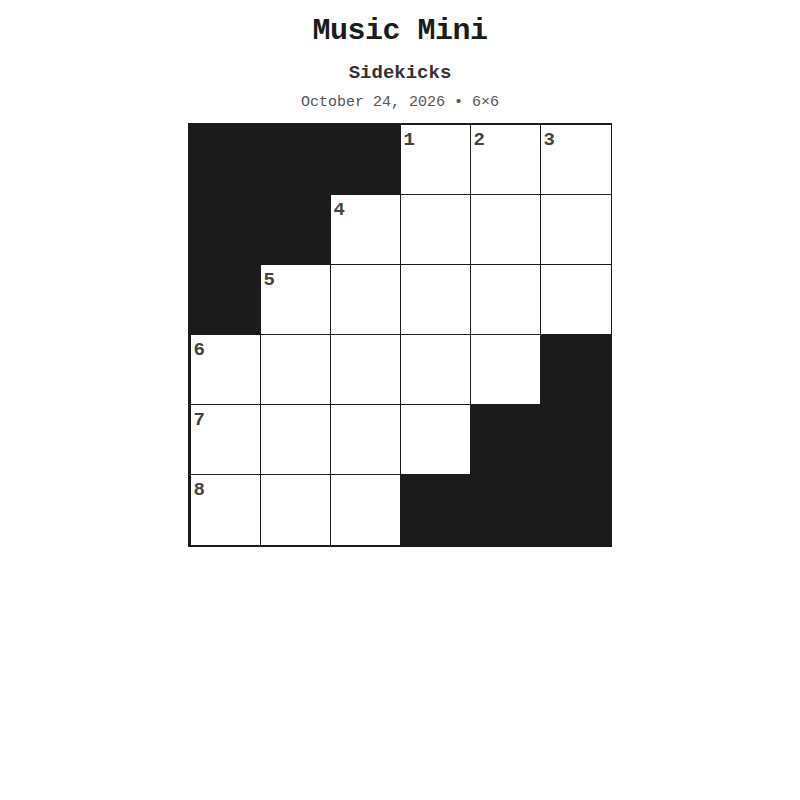 | This week's puzzle gives some love to the less-feted cats in some famous outfits. PLAY NOW |
| About Stems To learn more about Stems, visit the About page. To learn more about my consulting practice, visit here. |
| Sponsored message |
The holiday streaming season is almost here

Are you ready? As revealed in our holiday playbook, Roku Ads Manager lets you easily set up, measure and optimize your self-serve holiday ad campaign. You can even create a shoppable ad unit that lets streamers buy directly from their remote.
