Stems is back from vacation in Colombia, home to wonderful people, natural beauty, old world charm, 90% humidity and endless bird species. A special shout out to the one other New York Knicks fan at the empty Cartagena sports-hookah bar where our group watched Game 4 of the NBA Finals — it was great to have somebody else to high five.
We also have a new publication day! Out of respect for summer fridays, Stems will be hitting your inbox on Thursdays moving forward.
 MUSIC • MEDIA • TECH
| Roundup |
Being the Anti-Spotify is Turning into a Great Business Plan for Qobuz

As stated in a recent issue, we enjoyed our recent Qobuz road test, so we were happy to talk to the French music streamer's U.S. managing director, Dan Mackta. The excuse for the conversation was Qobuz's announcement this week that they grew by a hearty 45.7% in 2025, more than five times faster than the streaming industry overall.
I was interested to hear Mackta give Liz Pelly’s 2025 Spotify critique Mood Machine a lot of credit for Qobuz’s growth. “A lot of [the growth bump] definitely lined up with the release of that book and that initial burst of coverage,” he says. “Artists were already decrying low revenue from streaming. Some of the stuff in that book confirmed things that people suspected.” Largely because it’s an entirely paid service, with no free tier or ads, Qobuz is able to pay artists multiples per stream of what they would make at other DSPs. Unpaid endorsements from social media influencers switching from Spotify often mentioned that fact, as did plugs from celebrities ranging from Chelsea Handler to filmmaker Alex Gibney. “We started to see our numbers edging upward. It felt like everything we were doing was working better.”
Then the news broke that ICE recruitment ads were running on Spotify. “That was our biggest day ever,” says Mackta. The new subscriber numbers were so off the charts that he thought it was streaming fraud. “Straight up,” he says. “I woke up and I’m furiously sending messages to our CTO like, Massive fraud. I don’t know what happened.”
Mackta got his start in indie-rock — he was the co-owner of indie PR company Autotonic, who repped Pavement, Guided By Voices, and Belle and Sebastian in the 1990s, and later worked at RCA and Razor & Tie — and sees the parallels at Qobuz. Its 1.2 million subscribers are what Mackta calls a “rounding error” for the major streamers, and it’s run for pennies on the dollar compared to the competition: it has a hundred or so employees worldwide, compared to Spotify’s 7000-plus employees. Mackta has a grand total of 7 full-time people on his U.S. team to handle all marketing, business development, label and artist relations, partnerships, editorial and playlist programming — business functions that are handled by large divisions at the major streamers. “[With indie labels] it was all word of mouth and doing what you could with the resources you had to stimulate that. That’s the boat we’re in.”
Helpfully, Qobuz offers a pretty simple value proposition: a curated front page that feels like a 'staff picks' section at a good record store, along with magazine-style music writing, and lossless tracks for purchase. "It's a pretty straightforward, cool service," says Mackta, "The people who are going to get it, get it almost immediately, and really like it." He says that the music writing gets read by a "low double digits" percentage of subscribers (which is actually higher than I expected), but that he sees it as a "key differentiator." "I think even if people don't read it, they probably like that we have it." When it comes to adding new product features, Qobuz sticks to the "non-controversial" ones that customers expect, says Mackta. "The music keeps playing if you want it to," he says. "That's pretty elementary." But Qobuz isn't the service for you if you just want the algorithm to pick what you listen to. "That's not our forte. We say, if you want the world's greatest algorithms, there are some giant tech companies that have fantastic ones."
Mackta sees the Qobuz audience as “virtually limitless.” “The only problem is we’ve got a funny name and we’re competing against some of the biggest companies in the history of capitalism.”
“Thankfully people like the product,” he says, “If they didn’t, none of this would work.”
| STUBS |
Berklee Feels Like AI Music Ground Zero
Smart piece in the Economist on how and why countries around the globe are listening to more and more homegrown music. Key causes: digital technology bringing down production costs, changes in how artists make money and deregulation.
Stems attended Berklee's AIMS AI Music Summit the other week, which was pretty fascinating; in some ways Berklee feels like ground zero of so much happening in AI music. For one, it's in Suno's hometown and has had some ties to them, as well as many other music tech companies — plus many, vocal students who loathe Suno and AI music as a concept. More to come.
Belle and Sebastian wrote an anthem for the upstart Scottish national team. I think I liked them better when they wrote about hating sports like any good indie rocker.

Stuart Murdoch releases a gentle-hearted World Cup anthem.
| Recommended |
More Should Be Cooking With Ovven

Ovven's debut album Gnawing at the Cord came out in February, so I would normally be abashed on how late I came to it; I've been playing it on repeat for just a few weeks now. But it seems to be flying under everybody else's radar as well, with the notable exception of Steven Hyden (and my buddy Alex Pinto). Hyden has suggested that Cord could be 2026's Manning Fireworks, which works; it was produced by MJ Lenderman collaborator Alex Farrar, who knows how to make great-sounding alt-rock. Gnawing at the Cord is much more of a guitar record, though, on the order of Built to Spill, Dinosaur Jr. or Son Volt at their most cranked-up; you can also hear some Steve Miller or Joe Walsh under the surface. Chicago-born, Nashville-based Owen Burton writes about Rust Belt aimlessness and longings that don't have any easy resolution. "Embarrassing" is a rough, autobiographical picture of young guys who don't have each other's backs when it counts, and what that feels like. One of my favorites, "Dishes," is about being stuck and antsy: "I wish there was more dishes to do so there was something for my hands," sings Burton. Spoiler: He got unstuck. As far as I can see, Gnawing at the Cord hasn't made any best albums of 2026 so far lists, but I wouldn't be surprised to see it on some year-end ones.
| Crossword |
This Week's Music Mini is Truly Alt
Alternate Spellings • June 18, 2026 • 5x5
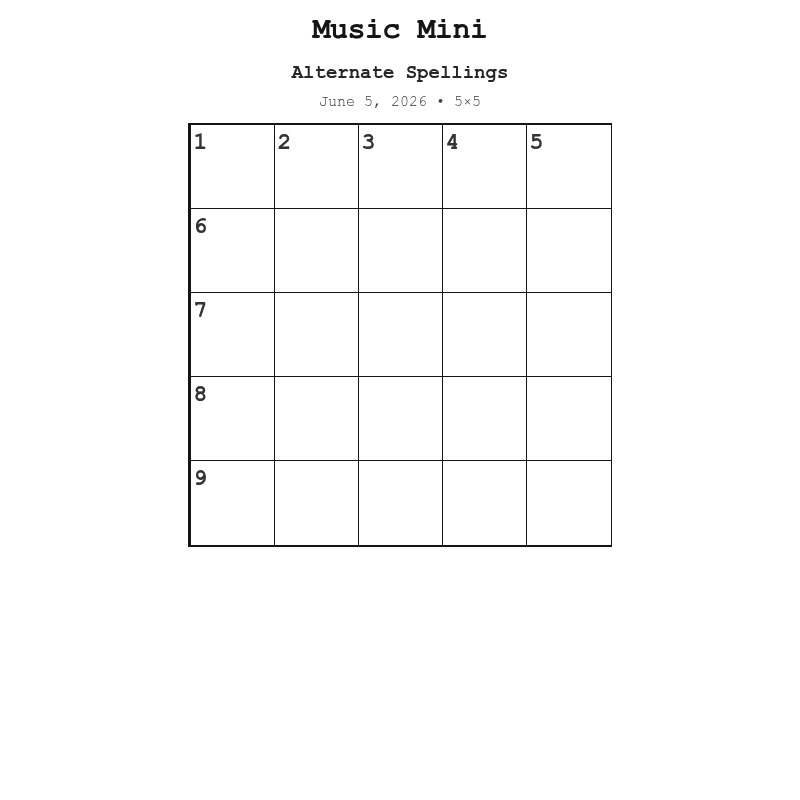 | Musicians love alternate spellings, and you will too after you finish this week's Music Mini PLAY NOW |
How was this week's Stems?
| About Stems To learn more about Stems, visit the About page. To learn more about my consulting practice, visit here. |