
Welcome to Stems, a weekly newsletter about music, culture and tech.
The name comes from audio stems, the building blocks of a record. My goal is to capture the split-screen life of music in 2025: songs and spreadsheets, anecdotes and data, creativity and technology. Sometimes they converge, sometimes they clash. Music has always been driven by technology -- as Pythagoras and Dylan both noticed, it's all just math. Yet nothing prepared us for AI models ingesting the world’s recorded catalog so they can mimic Jason Derulo.
With that tension in mind, Stems aims to deliver both analysis and reminders of why we care. Every issue will include: 1) a news or data-driven piece that might tell you something new; 2) a recommendation on something worth your time; and 3) a crossword puzzle for obsessives (because why not). Send tips or feedback to [email protected]. And thanks for reading!
The Artist Bio Doc Bubble is Bursting
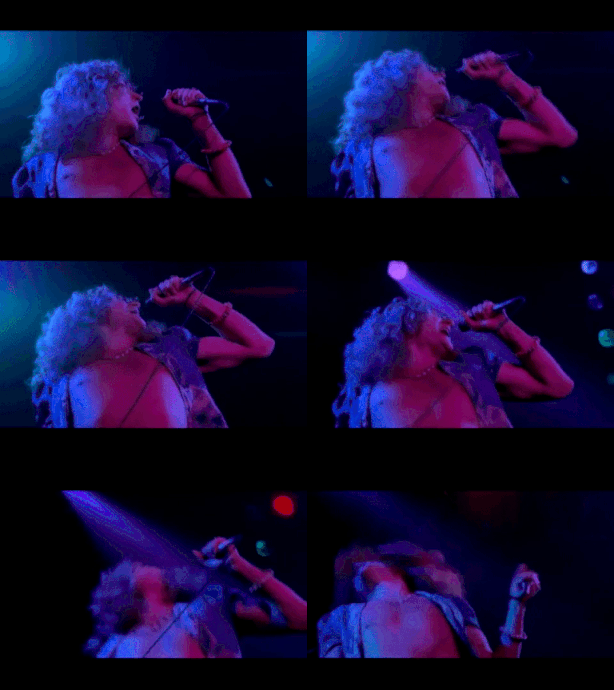
‘Becoming Led Zeppelin’: ‘Hammer of the Gods’ it ain’t.
The 2020s have been a hot time for music documentaries — particularly glaze-y, artist-approved bio-docs. For every Summer of Soul or The Velvet Underground, there’s been a campaign piece like Jennifer Lopez: Halftime, or a semi-historical effort with a narrow lens (Becoming Led Zeppelin). This current self-mythologizing trend took shape in the 2010s with docs like Beyonce’s Life Is But a Dream and Justin Bieber’s Never Say Never and picked up in the early 2020s with films like Taylor Swift’s Miss Americana, Billie Eilish’s The World’s a Little Blurry, and Selena Gomez’s My Mind & Me.
Exactly how big has the current wave been? To find out, the Stems research department tracked the number of authorized artist bio docs released since 2020:

2021 saw a big spike in bio docs, and 2024 was the biggest year yet, thanks to films like I Am: Celine Dion. Why? COVID and the huge success of docs such as ESPN’s The Last Dance probably threw some gasoline on the fire. Larger factors include the rise of streaming networks and slow decline of legacy media — given the dwindling number of meaningful media opportunities across print, traditional TV and radio, documentaries are an appealing device for stars who want to create a moment. An important compounding factor specific to music: unauthorized docs can be especially difficult to make, because you need an artist’s permission if you want to feature any of their songs.
There is data suggesting we have passed the peak, though. A survey of docs released in the first six months of 2025 vs the same period in 2024 shows a drop of more than 50%:

Whether this dip is a true reset or a blip remains to be seen, but there has also been a drumbeat of articles critical of the genre. That means that there’s less PR upside to artist-approved origin stories. The music docs that are getting more positive attention tend to be taking more chances, like The Greatest Night in Music or Eno. I’ll keep this index of docs current (see the methodology box at the bottom of the page for how I put it together) and I’ll update the chart at year’s end. Let me know what I’m missing at [email protected].
The Most Subversive Hour on Television: Sacha Jenkins’ “Sunday Best” Reframes Ed Sullivan

The Supremes on “The Ed Sullivan Show” in 1966
I met Sacha Jenkins in the mid-90s, in his magazine Ego Trip’s one-room office in Astoria, Queens; I was there to interview Sacha and his then-partners Elliott Wilson and Jeff “Chairman” Mao for Time Out New York. Sacha was a big, gentle guy with a serious deadpan wit who had a way of cutting through small talk. Later he wrote for me at Rolling Stone and was music editor at Vibe for a minute, but more than anything, he was a remarkable entrepreneur and creator (before that was a thing) who found ways to make the books, magazines and docs he wanted to make, on the topics he always came back to: hip-hop, race, culture and power. (A few of his greatest hits: Ego Trip’s Big Book of Racism and the killer docs Fresh Dressed and Wu-Tang: Of Mics and Men.)
Sacha died in May, from complications from a longstanding illness. His final project to see the light of day, Sunday Best (Netflix), is a powerful sendoff. It captures how Ed Sullivan did something radical by putting Black artists—Harry Belafonte, a 13-year-old Stevie Wonder, The Supremes, James Brown, hundreds of others—on national TV in the 1950s and 60s, often over the objections of sponsors and Southern white viewers. The performances alone are worth the 90 minutes: Belafonte’s “Muleskinner Blues,” Wonder getting a very white crowd chanting and clapping with “Fingertips”. At a time when the music industry is focused on serving superfans with familiar music, the film is a reminder that simply putting great artists in front of people can change the culture.
None of this was inevitable. Lincoln-Mercury pulled their sponsorship in the early 60s, citing Sullivan’s bookings and his public shows of affection for Black artists such as Pearl Bailey (Sullivan kissed her on the cheek in front of the cameras). Sullivan stood up to the pressure; when a Ford exec complained at one broadcast, he had him tossed out of the theater.
Of course, as Bob Iger might protest, we are in a hugely different media environment now — broadcast networks and talk shows have never been weaker (and they are also booking less music). But the lessons of Sunday Best remain: choices matter, and sometimes the world comes around to them. Thanks for this one, Sacha.
Introducing the World’s Finest Weekly Music-Themed Mini Crossword Puzzle
Like many people I know, I’m pretty obsessive about NYT Games, which made me wonder why there are no decent music-based puzzles out there. So for fun I’m going to do a regular mini crossword each week. There’s a timer built in, and based on how fast you finish, you’ll get a 1-5 star rating (apologies - old habits die hard for former record reviews editors). Get it done in under 30 seconds (not easy) and get 5 stars.

How was today's newsletter?
Consulting: [email protected]
LinkedIn: /in/nbrackett