Stems is one year old! Thanks for reading, whether you are a day one Friend of Stems or a brand new subscriber. Send hot tips, NYFF tickets and feedback to [email protected].
Was this forwarded to you? Sign up for year two by subscribing to Stems here.
 MUSIC • MEDIA • TECH
| Analysis |
“Choosin’ Texas” Is a Cool Song, but Its Record-Breaking Chart Run Might Be a Bad Symptom

Stems is all for “Choosin’ Texas” but hopes that Texas doesn’t choose Ken Paxton.
It’s been a few weeks since Ella Langley’s “Choosin’ Texas” became the longest-running #1 song on the Billboard Hot 100 ever, and folks are still chewing over what it all means. Some have called it more evidence of country music’s rise (fair enough — but don’t forget that hip-hop still accounts for 25% of all streams, making it the number one genre in the U.S., with about 2.5 times country’s share). It’s undoubtedly a welcome return of women to the top of the country charts. Bob Lefsetz held up the single as more proof that we’re all in our own filter bubbles. And NPR reminded us it’s a good song.
No argument with that last point, but, as others have pointed out, you can’t deny that “Choosin’ Texas” is unusual for a 21st-century mega-hit. Most big smashes these days are attention-getters — they feel like a party (“A Bar Song (Tipsy),” “Uptown Funk”), or Christmas (you know who), or sound like something new-ish (“As It Was,” “Old Town Road”). “Choosin’ Texas” is a wistful, gentle chugger with a ’70s-style country-rock guitar hook. It rides the line between sleepy and awesome; it’s like a comfy old t-shirt that you somehow just bought at Target.
It also works as both background and foreground music (or, if you are speaking in tech, it appeals to both ‘lean-in’ and ‘lean-back’ customers). Often, the biggest songs on streamers aren’t the ones that grab you by the lapels; they’re the ones that hold up to repeated listens and fit into people’s lives. Listeners are streaming more algorithm-picked music than ever; by some estimates, more than 60% of streams on Spotify are algorithmically fed. Ella Langley has lots of superfans who are buying thousands of digital downloads every week, but “Choosin’ Texas” is also well built for passive listeners who are handing the aux to Spotify’s AI DJ, asking Alexa to just ‘play country music,’ or letting their music streamer pick the next song via infinite play. To be a huge hit these days, you need to be a song that people aren’t turning off.
“Texas” reflects another macro trend: big songs are spending more time at the top of the charts these days. As Billboard recently illustrated, a decade ago a typical chart week might have included one Top 20 song that had been on the charts for 30 weeks or more; in contrast, nine of the Top 20 songs in a sample 2026 week had been on the charts for that long. Part of that is for an obvious reason: Once the streamers see that you aren’t skipping a song, they know to keep playing it for you.
At my old place of work we had something that one wag named the Imagine Dragons Effect. Imagine Dragons were getting streamed in huge numbers, particularly by kids who presumably have a large appetite for repeat (and repeat and repeat) listens, which meant they got prioritized by the recommendation engines; that led to even more streams, which led to more prioritizing of Imagine Dragons by the algorithm, and so on and so on, until it sometimes seemed like Imagine Dragons were the only thing that anybody on the service ever listened to.
Recommendation engines have gotten smarter since then, i.e., they are better at not serving you Imagine Dragons if you aren’t going to like them. And there are many other reasons that people give for the lack of dynamism on the charts (a couple of them: fans overwhelmed by choice are gravitating toward a smaller group of mega-stars, and the traditional gatekeepers have less ability to push new music). And to be fair, it’s worth noting that streamers spend a lot of resources and energy on helping subscribers find new music.
But you have to wonder if there isn’t a little of the Imagine Dragons Effect behind the lack of movement at the top. And you also have to wonder if the fact that catalog listening is growing and new music listening is consistently going down in market share is related to this. Is the abundance of music streaming actually making the music industry more static? It’s not the fault of “Choosin’ Texas,” but maybe it’s not a good thing, as Andrew Unterberger wrote in Billboard, that if it had “come out two decades earlier — really even one decade earlier — not only would it have no chance of spending that long at No. 1, it likely wouldn’t have sniffed the top spot at all.” In a world with near-infinite music choice, do we want fewer big hits? Let’s hope that more isn’t equaling less.
| ON THE TOWN |
On the Ground at NYC Geese Week

The kids like Massive Attack! Forest Hills, October 3rd.
Geese were in the air in the Five Boroughs last week, and Stems was there for it. The stage was set last month by Friend of Stems Simon Vozick-Levinson’s nice Rolling Stone cover story on the band, in which they effectively turned the page on the whole Chaotic Good / digital marketing flap from earlier this year (which, let’s face it, already feels like eons ago). They addressed it pretty charmingly: When asked about Wired’s shameless “The Fanfare Around the Band Geese Actually Was a Psyop” headline, Winter joked, “I thought the same thing, I really did. That seemed like a reasonable explanation,” adding, a little more seriously, that “we learned that we should show up to Zoom meetings about how our record’s going to be advertised.” Young artists in potential crisis-PR situations should take notes.
The first highlight of the week was the Friday screening of Paul Thomas Anderson’s Cameron Winter at Carnegie Hall, a powerful document of Winter’s December 11, 2025, show. The accompanying album, lovingly produced by Ariel Rechtshaid, is out today. Anderson shot the show in gorgeous 16mm and 35mm film, and he approaches each song from a subtly different angle. My favorite part is the segue from “Try as I May” into the unreleased “Emperor XIII in Shades”: Anderson removes the applause and pulls back for a wide shot of Winter as he plays the last note of “May,” creating an arresting, lonely moment where much of the screen is black; you feel like the only person in the audience. I wasn’t at the actual show, so I can’t say that the movie is better, but it feels like it might be.
Geese’s October 3rd Forest Hills Stadium show was the opposite of lonely: a celebration of the band’s huge year with an all-ages hometown crowd that was bouncing and benignly moshing in front of the stage. As he did the night before, Winter gave a tip of the chapeau to Queens neighborhood legends the Ramones, playing a snippet of “Now I Wanna Sniff Some Glue” on his phone. But the miracle of Geese is that they sound only like themselves and have won over a huge audience doing so.
As a final, marginally Geese-related side note: Less essential than Carnegie Hall but worthwhile was a September 30th New York Film Festival screening of Jonathan Glazer’s short documentary Joy of Joys, about the Abbey Road Studios sessions behind HELP(2), a benefit album raising money to help children in war zones around the world and featuring Olivia Rodrigo, Damon Albarn, Fontaines D.C. and a cameo from Winter. Powerfully, Glazer handed over cameras to children in Ukraine, Gaza and other war zones for short segments, but the heart of the doc is London schoolchildren filming the artists at work, which is very effective at disarming them. (Making-of-album documentarians, remember that one.) Winter amusingly tells his young cameraperson that he was excited to come to Abbey Road until he realized that he would be shunted off to one of the cave-like, smaller recording rooms. He’ll probably be in a bigger room next time.

Mosh pits could be more disturbing in the ’80s and ’90s. (Photo credit: @geesebandnyc)
| Crossword |
The Music Mini Crossword Flaps Back
Waterfowl • October 9, 2026 • 5x5
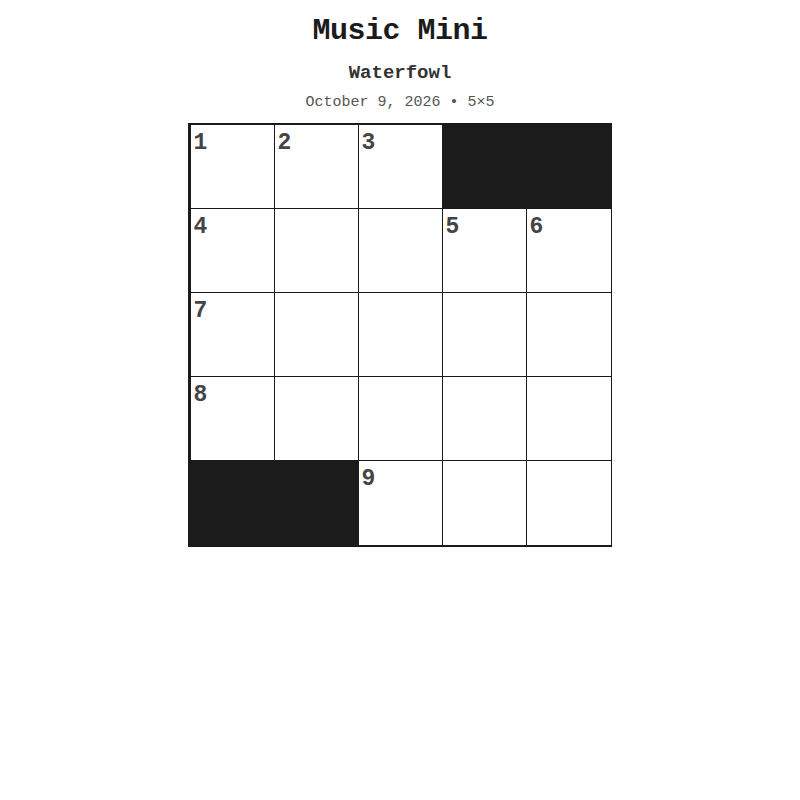 | Geese and Goose are just the latest links in a chain that connects popular music and water birds. PLAY NOW |
How was this week's Stems?
| About Stems To learn more about Stems, visit the About page. To learn more about my consulting practice, visit here. |
| SPONSORED MESSAGE |
Your K-Cups Sat in a Warehouse for Months

Grocery store pods spend months going factory → warehouse → truck → shelf, losing the flavor oils that make coffee taste like coffee. Angelino's roasts, packs, and ships within days — 50+ flavors, compatible with Keurig®, from 39¢ a cup. New customers save 15%, no code needed.