Maybe it’s because we are on a reduced summer publishing schedule, but Stems is offering a marginally positive take on the state of music and AI this week. (Tune in next issue for our usual programming). Hit us up with feedback, tips and feel-good stories at [email protected].
 MUSIC • MEDIA • TECH
| Analysis |
Against All Odds, the Music Biz Might Be Getting Its Act Together With AI

Giphy
Could it be that the music biz is actually (gasp) leading the way in reining in some of AI's worst caprices? The last couple months have seen emerging consensus around the need to identify AI-generated songs, along with a flurry of legal activity aimed at getting artists and rightsholders paid.
Most recently in the former department (a.k.a. “Hot Tag Summer”), last week Apple Music told distributors they'll be required to tag any track where AI generated a "material portion" of the song, making the previously-voluntary Transparency Tags the streamer rolled out earlier this year mandatory. Before that, on August 11th, Spotify announced it would be adding "AI Persona" badges on the profiles of AI-generated artists, and would bar those acts from its editorial and algorithmic recommendations. The next day, dance portal Beatport took it further, announcing that it would reject fully or majority AI-generated tracks.
At the same time, there has been a drumbeat of legal action aimed at getting artists and rightsholders paid for their unknowing contributions to AI training models. To make sense of the biggest beats this summer, Stems spoke to heavyweight music lawyer Ken Anderson, a partner in the Entertainment, Sports and Media practice at Rimon Law and a fixture on Billboard's Top Music Lawyers list. The first on our list to discuss was the win by German rights organization GEMA against Suno a few weeks ago in a Munich regional court. Germany (and the EU in general) have always been aggressive in regulating big tech, and Suno may appeal, but the ruling was still significant: for one, it reached across the Atlantic, asserting that Suno’s training activities in the United States violated applicable U.S. copyright law. Second, it found that Suno had stored protected works in its model and produced outputs that closely matched them. AI models rely on a randomization process “that's supposed to be the equivalent of humanity — the spark of genius,” says Anderson, “But what the court said is that only comes into play down the road, after the songs were copied intact, completely, inside the application. That's the part that matters.” Suno, presumably reacting to the GEMA ruling and the overall climate, has announced measures to curb the flood of AI music onto the streamers, upcoming AI watermarking tools and a new deal with BMG. (For a translation of a recent announcement, see Drew Thurlow’s epic guest post in last week’s Stems.)
Less-trumpeted but also important was the American Federation of Musicians' suit against UMG and Warner over their deals with Udio and Suno, respectively, which didn't include a payment or credit for the musician union’s members. Anderson likes this complaint because it underlines the notion that major label negotiations with AI companies are not likely to benefit most artists and rightsholders.
“The assumption that these multinational corporations are the caretakers of the [AI] problem is a big mistake," says Anderson. He points to the long history of major labels cashing in on new technologies and distribution channels without that money filtering down to artists. A much-cited recent example is the labels taking equity stakes in Spotify, but Anderson traces it to ‘breakage,’ the decades-old accounting maneuver dating to the Columbia House record club era. “You negotiate a series of massive advances against royalties, calculated in advance to far exceed what will actually be earned,” he says, “That surplus goes to the record company, because the contract says the artist doesn't get to know anything about it. That scenario repeats itself with each new technology that comes along.”
UMG is trying to get the AFM lawsuit dismissed, and it’s still too early to say where all of this goes. But against all odds, in its own decentralized, bare-knuckled, litigious way, the music world appears to be making progress in making AI work for everybody. "We're a few steps down a very long road,” says Anderson, “But the steps that have been taken at least seem to be on that road — as opposed to steps going in the opposite direction."
| CRITICISM |
Dave Marsh Got Into People’s Heads
Dave Marsh, who died on August 14th at the age of 76, has been remembered as many things – rock book legend, Bruce Springsteen champion, KISS-and-Journey-denier. As someone who overlapped with Dave Marsh for some years on the Rock and Roll Hall of Fame nominating committee, I can attest he spoke the truth when he said he “did his share to keep [KISS] off the ballot.” He brought a Detroit mindset to the annual meetings, and didn’t shy away from a little snark or ridicule when it came to making a point. I confess to thinking he was a slightly-scary grump when I arrived on the committee in the 2000s, barely out of my twenties and a little awestruck by the room of heavies that included folks like Ahmet Ertegun and Seymour Stein. When we were introduced, Marsh gave me a sick-flounder handshake and barely looked up. (He might have just had his game face on; we ended up at a SXSW thing together at a later date and he was friendly and funny.)
But — without completely agreeing with Kelefa Sanneh’s take on music critics being too nice these days — I do wish we had a few more scary grumps in the writing space. Marsh was unafraid to throw shade on artists he didn’t like because he understood the critic’s role: to have strong, coherent opinions and get into people’s heads with them, even if, in his case, it meant using something sharp, or blunt and heavy. The stakes were high for Marsh; rock and soul were serious business.

One thing I haven’t seen discussed so much is that — almost in spite of himself, because he was such a contrarian — Marsh was a defining Rolling Stone record reviews editor. During his time running the section in the mid-to-late Seventies, and in his pored-over Rolling Stone Record Guides, he articulated RS’s musical worldview at the height of its influence, even as he injected into it his own quirks (and, famously, pet peeves). He had already done and would go on to do many other things (Creem, 25+ books, Rock & Rap Confidential) but it’s hard to fathom how many record collections he helped populate because of those years, or the number of writers he inspired, either to be like him or take on the musical POV that they thought he embodied. Chuck Eddy, a fellow Detroiter of whom Marsh was an early supporter but who fell out with him in the ’80s, put it well on his Substack: “Dave Marsh will be missed. But I’m glad the chip on his shoulder will live on.”
| Crossword |
The Music Mini Crossword
Names and Places • August 21, 2026 • 6x6
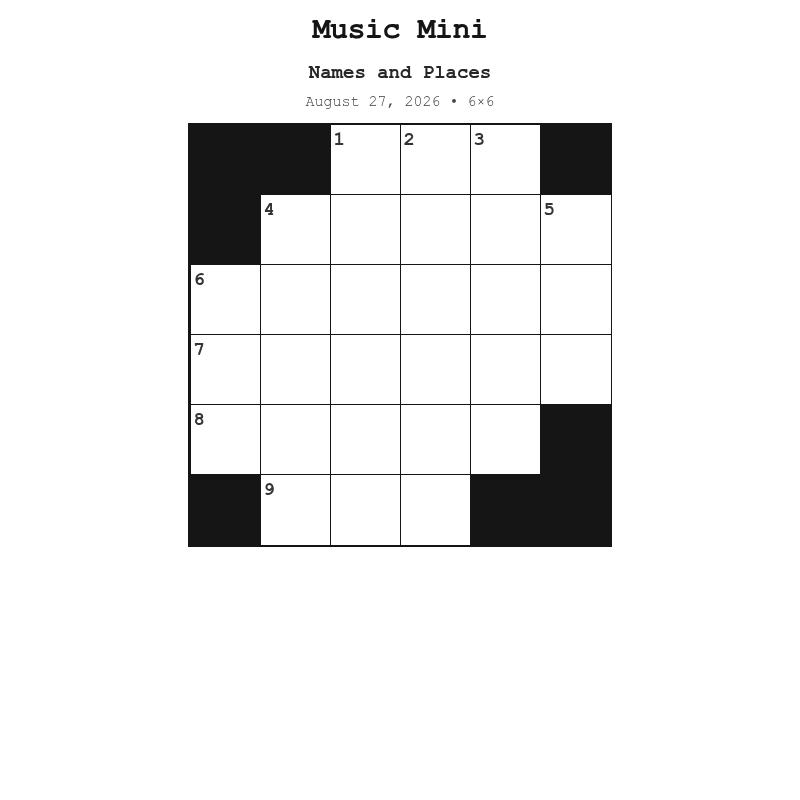 | Stems' hot crossword summer heats up with this location-heavy puzzle. PLAY NOW |
How was this week's Stems?
| About Stems To learn more about Stems, visit the About page. To learn more about my consulting practice, visit here. |
| SPONSORED MESSAGE |
Get 15% Off Coffee Pods Roasted Days Ago

Angelino's roasts, grinds, and seals 50+ specialty coffees in-house at their LA roastery, then ships within days. Mix and match to unlock up to 34% off — and new customers get 15% off on top, applied automatically. No code, no subscription required.